Monday, 14 January 2013

Tracking Portfolio Performance


I like knowing things. But sometimes I lack the native speaker’s grasp of a language to be fluently knowledgeable in matters foreign to my still-evolving mind. So I’ve been dragging my feet over calculating my portfolio’s return, because I’m not entirely confident of my math.

Which means I’m either going to make a passable effort, or fail spectacularly. Better to make the effort and be a good sport however it turns out.

So for the past few months or so, I’ve been tracking my daily portfolio value, by logging into my FSM account – why – so I can track my portfolio’s daily return – why – so I can compare my portfolio’s return with a risk-free rate of return: a certain 3.5% p.a. courtesy of the CPF-OA interest rate.

If my portfolio of investments fail to beat the risk free rate of return, then I’m just pissing away my time and money, and I’d be better off leaving my money in Singapore Government Bonds, which the CPF invests in. (On a side note, I found no info about the portfolio of the CPF monies i.e. which SGS Bonds they’re invested in…if anyone can point me in the right direction, I’d be grateful).

I thought calculating returns would be a simple task of calculating the difference between how much I put in versus how much I got out. Turns out, like many things in finance, it can get quite a bit more complicated if one so chooses.

Sure I can find out how much I made, but that’s not all there is to returns. I also want to know the magnitude of any positive/negative returns over a given period.

There are other limitations with a simple, 1-number measure of performance. That measure of performance, expressed in a formula is: (current value/initial investment)-1.

Firstly, it doesn't tell you which fund contributed to the portfolio’s performance. If a fund is losing money, I want to know about it, and whether it’s doing so because the market is crap in general or the fund manager has decided to dedicate his life to improving his golf handicap instead of generating returns.
Secondly, realized losses aren't captured. For example,

Say I held two funds from 2011 to 2012, with $1000 in each fund (Initial investment=2000, current value =2000, performance = 0%).
Two months later, one fund drops 50%, while the other remains constant. (Initial investment=2000, current value =1500, performance = -25%).
In a fit of anger, I realize my loss, selling all my units of that losing fund. (Initial investment=1000, current value =1000, performance = 0%).

Presto, I've no longer incurred a loss on my portfolio. This is problematic because it doesn't provide an accurate measure of the performance of my portfolio. (it hides the losers, while illuminating the winners. Survivorship bias anyone?)

So I’m left with the challenge of finding a way to track the performance of my portfolio, adjusting for various ups, downs, ins, and outs of its performance.
In the 1800s, the intelligentsia thought having heretics wear dunce caps would improve their intelligence. Sadly, neither intelligentsia nor heretics have matured much since then. (Source: http://commons.wikimedia.org/wiki/File:Scene_from_an_Inquisition_by_Goya.jpg)

Monday, 24 December 2012

Portfolio looking fair


It’s been a full month, but as 2012 comes to a close, a quick look through my portfolio seems to be in order.

Last accessed 23 Dec 2012, the portfolio’s return from Oct 2011 stands at 4.84%. Everything seems ok, with exception of BNPPL1 Opportunities USA USD, which has yet to recover from its performance in 2011 and 2010.


To illustrate how badly the fund has done, Citywire ranks François Mouté (manager for the fund) at bottom of North American ranking tables over 12 months, and 36 months. 

source: Citywire.com

Each time my eyes glance past those numbers, my mind starts coming up with questions like:

“Has he lost his mojo?”
“Is he more interested in retirement than returns?”
“Is Moute french for Miller?”

It’s a risk all active funds face. The chance that a star manager, for whatever reason – be it personal challenges (i.e. life happens), or professional challenges (i.e. the ceaseless grind of the performance derby on one’s soul) – decides it’s time to cash in the chips and live off bank interest. I claim no expertise in judging the psychology of fund managers. I’ll take a look at the numbers, and decide what to do from there.

New additions: I picked up Amundi Gbl Luxury & Lifestyle SGD, for lack of a better global equity fund. I would love to see something better catch my eye. Funds on the radar include Aberdeen Gbl Opportunities or DWS Invest Top Dividend. 

Meanwhile, I wrote previously about agonizing over the decision to switch out of Legg Mason WA SEA Special Situations. Happily, or from sheer luck, both funds performed pretty much identically since roughly end-Sep 2012:

Source: Fundsupermart.com


Both funds returned around 8% in 3 months, and short of any potential slowdown, I’ll stick with Legg Mason since historically it has done well in rising markets. 


A bet on HK via Aberdeen China has finally paid off, netting about 6% returns, and I might hold that for some time more.

The fixed income segment of the portfolio looks healthy, and thankfully so, since it’s propping up my portfolio against the returns from BNPPL1 Opportunities USA USD. I’m not about to change anything on this area of the portfolio.

Real estate, via Henderson Global Property is another strong performer, returning 10% since it appeared in the portfolio.

While I’m more or less satisfied with Threadneedle Enhanced Commodities, it is pretty volatile, and I’m keeping an eye on DB Platinum Commodity RIC-C SGD Hedged if the former continues to track the latter.

Monday, 3 December 2012

Blissfully Olam Free Funds


I haven’t read anything about fund exposure to Olam, so I figure this would be blogworthy.

19 November, Muddy Waters’ Carson Block is quoted by Jesse Westbrook for Bloomberg, saying he is betting against Olam. Requote: “We think the company will fail.” And with the recent saber rattling between Olam vs Muddy Waters, I’d thought it’d be worth a little time to dig up all the end-October factsheets of the various Singapore equity funds to see if any fund managers had a position in the neck-deep-in-Muddy-Waters Olam.

Based on end-October factsheets, none of the following funds on Fundsupermart have listed Olam in their top holdings.

Olam-free Singapore Equity funds
Olam-free Singapore Bond Funds


source: respective factsheets, as at end-Oct 2012

This doesn’t discount the possibility of being exposed to Olam; since top holdings are only updated on factsheets monthly, there’s the possibility of a fund taking a position between 1 Nov 2012 and 19 Nov 2012, which would then expose the fund to Olam’s share price movements. 
source: Yahoo!Finance, last accessed 2 Dec 2012
Looking through Olam’s 2012 Annual Report throws up a list of shareholders, with some pretty big names, as well-reported in the media.
Source: Olam 2012 Annual Report, last accessed 2 Dec 2012
As far as I’m aware, the asset management firm there with any sort of retail presence is AllianceBerstein, and parent, the AXA Group. But, as they’re not present in the Singapore equity/bond space, I’ll leave it at that for now.

Tuesday, 13 November 2012

Why I Choose Funds Over Stocks

Note: This article was originally written for MyPaper. Sadly, due to layout constraints one chart didn't make it.


Here’s the reality: many local investors would be better off investing in a Singapore equity fund.  Am I saying all investors would be better off? No. There’s every chance a savvy stock picker will see their portfolio performance outperform the market. But not everyone has the time or inclination to wade through years of annual reports and mountains of data, and such people are a relatively small part of the population. 

So a good number of local investors would be better off in a fund.

Here’s why.

Singapore fund beat the STI over long time periods
The Straits Times Index is the benchmark index for the Singapore stock market, and consists of the 30 largest companies listed on the Singapore Exchange. Aberdeen Singapore Equity Fund is a portfolio of equities managed by Aberdeen Asset Management Asia. The fund is one of the longest running funds in the business, having launched in December 1997. 

Disclosure: I have a position in the Aberdeen Singapore Equity Fund.
Source: iFAST compilations, in S$ terms, dividends reinvested, extracted 2 Nov 2012.
The data shows, S$100 invested in the STI and the Aberdeen Singapore Equity Fund would have seen remarkably different growth over more than 14 years. From end-97 to end-Oct 2012, $100 in the STI would have grown into $202, while $100 in the Aberdeen fund would have grown into $472. I’d wager few, if any, stocks on the STI can boast similar growth over the same time period.

Singapore fund beats the STI over good and bad market conditions
To get a clearer picture of how the fund does in good and bad markets we look at the yearly returns of the fund against the STI. For simplicity, a year that sees positive returns is ‘good’, while a year that sees negative return is ‘bad’. A fund does better when it beats the benchmark.

Source: iFAST compilations, in S$ terms, dividends reinvested, extracted 2 Nov 2012.

More often or not, the fund beats the benchmark. In 9 good years, the fund did better 6 times. In bad years, the fund did better 5 times. Again, I’d wager few, if any, individual stocks can post similar performance.

Granted, an individual stock might outperform the STI and the fund for an extended period of time. But bearing in mind many of us, the author included, are not savvy stock pickers, the question is, “What are the odds of an individual picking such a stock?”

Many Funds Beat The STI in 2012
Passive investing purists will rightly point out I’ve only considered one fund. What about the rest? 

To be fair, Aberdeen Singapore Equity is the rare fund with 14+ years of track record we can pit against the STI to show an actively-managed fund can indeed beat an index. From end-2011 to end-Oct 2012 (also termed as ‘year-to-date’), a total of 12 Singapore equity funds have posted returns greater than the 15% STI return. 

I’ll just name three, including the Singapore Dividend Equity Fund, Amundi Spore Dividend Growth, and JF Singapore, but if you’re really curious, you can head down to Fundsupermart.com, and generate a list of Singapore Equity Funds to look at.

And that’s why, in the case of Singapore equity at least, I’ll choose a fund over a stock any time.

Thursday, 8 November 2012

Why Finance Needs Bloggers


Like Hugh Young says, the finance industry is essentially venal. I wish I could read the entire interview where he says it, but because the financial publishing industry covers, well, finance, the interview is hidden behind a venal paywall.

So I tend to think financial blogging is a good idea when it comes to exchanging opinions about all things financial. Singaporeans in general don’t have a whole lot in the way of unbiased financial advice. Possibly because the word advice has subverted by financial advisors, 80% at least 30% of which are well, venal.

The other side is the mainstream media, which, rather than cultivate a diversity of financial viewpoints, has focused almost exclusively on the local stock market. Sure, there is some basis for this approach, after all, it’s a safe story to write, and you know there are a ready pool of stock investors in the local market that you’ll never have to worry about no one reading about SIA’s disappointing 1H2013 or the Heineken/Thai Bev tussle over Asia Pacific Breweries.

But what you gain in safety you lose in experience, and when you cover a world as fast-moving as finance, a diversity of experience is required to keep tabs on all the innovative ways this industry works to speculate on uncertainty. How many people did you know said anything about DBS High Notes 5 prior to the Lehman Brother’s collapse? Could this have been avoided by more honest opinions and better discussions among individuals? No one really knows, but it wouldn’t hurt.

If one were to do a poll right now, and asked the average equity-only investor on the features of a managed futures is, or a fixed income fund, or a multi-asset strategy, or a hedge fund, or a macro strategy fund, or a structured product, or a foreign currency time deposit, or a finglefangledoodletwat, I think most would have better luck describing that last term.

I’m not calling for people to take a position on where the market is going or trying to bet on the next financial crisis; only to venture authentic opinions, clearly backed by evidence, logic and data where available. Like one Chan Chun Sing says, “Diversity is a survival strategy.”

And now I’m going to attempt to come to terms with quoting the same guy who made the Lanfang Republic of ancient China famous. At least his speeches have gotten better over time.

Sunday, 14 October 2012

Screaming buy, 12 months later...


Approximately 1 year ago, I wrote an article, saying two markets were screaming buys if investors could hold for a year.

The date was 22 November 2011; the call was 22 November was an attractive entry point for Singapore and Hong Kong, and in Asia ex Japan equity markets. I’d like to say I did deep economic analysis of the markets, but it was based mostly on valuations.

Since 22 November, all three markets have shown 10%+ returns.

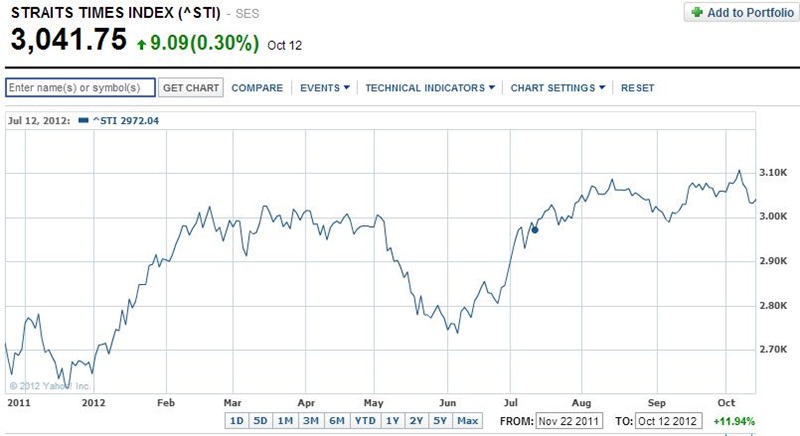
 The Hang Seng Index, representing the Hong Kong market, is up 15.81%, in HKD terms. Meanwhile, closer to home, the STI is known to be the boring sister to the HSI…
Image credit: http://finance.yahoo.com
…but that didn’t stop her from putting in 11.9% returns since 22 Nov 2011 in SGD terms.
Image credit: http://finance.yahoo.com
In USD terms, the MSCI Asia ex Japan (represented by its iShares ETF) returned 13.3%.
Image credit: http://finance.yahoo.com
Like I mentioned, there wasn't a whole lot of intelligence behind this decision – it’s essentially a look at valuations, which, at the time, were way low. Maybe it’s blind luck, but it’s always nice to know I’m right. This time anyway.

Sunday, 30 September 2012

Picking The Right Horse For A Small Cap Fund


For the longest time, I’ve worried about the performance of LM SEA Special Sits in my portfolio. Finally, I’ve found the time to compare the alternative I’ve been mulling around my head as a replacement for the fund – Aberdeen Asian Smaller Cos.

As at 30 Sep, here’s what my portfolio looks like:

Despite making a bit of money in the recent upsurge (thanks QE3!), I’m still facing a loss on my China exposure, and my US exposure, which proxies for developed equity exposure, because…well…I couldn’t find a compelling global equity fund (although DWS Top Div might be an interesting proposition).

In any case, this article tracks my thoughts on whether I should change my exposure to Legg Mason QA SEA Special Sits to Aberdeen Asian Small Cos. I find writing this down gives me a point of reference for the future, so I can have a clearer idea of what in the world I was thinking when I made the decision, or to leave a digital trail to prove my sometimes questionable frontal lobe activity.

In any case I wrote about these two funds approximately a year ago, when I compared both of them against one Mr Madoff, who had delivered 10% annualized returns consistently until the day his Ponzi scheme collapsed. The funds since then have posted far more modest rates of return because the start and end-points have changed. And the Madoffs, post Ponzi collapse, have also faced a drastic change in lifestyle.

For sake of comparison, I’ve used the MSCI Asia Pacific ex-Japan index (MXAPJ:IND) as a common benchmark. The two official benchmarks are MSCI Far East (MXFE), and MSCI APJ Small Caps (MXAPJSC), which are close enough for the MSCI Asia Pacific ex-Japan index to provide a fair proxy.


Granted, neither fund uses this benchmark, but the other two benchmarks used track fairly closely, so I think it’s a reasonably (but certainly not perfect) useful benchmark.

In any case, enough yap flapping. This is how the two funds stack up:


From the above, it’s quite clear both sit on opposite sides of the spectrum – Legg Mason will do badly in down markets (like 2011) and will do well in up markets, often stunningly so, with an average outperformance of 40pp in strong bull markets. Meanwhile, Aberdeen, true to its reputation for being conservative stock pickers, does well in bear markets, but underperforms in bull markets.

So should I switch? If I do, it’ll be because I believe there’s more pain to come, and that Asian equity markets will get hammered, and from a valuations standpoint, it’s kind of middle of the road, so there’s little guidance there. In other words, markets seem rather wishy washy, and to quote the reformed broker, “Tops are a process, Bottoms are an event and Middles are a motherfucker.”